OpenQuiz works in Claude through a connector. It links Claude to your own OpenQuiz account, so a conversation can create flashcard sets and whole learning paths, add your own word lists, quiz you, and save what you got right or wrong to your OpenQuiz progress and spaced-repetition schedule.
OpenQuiz is a vocabulary app with flashcards, spaced repetition, dictation and speaking practice. Claude is good at writing a word list. A list in a chat is not a study system, though: it has no review dates, no audio, nothing to type. The connector joins the two. Claude writes the cards, and OpenQuiz keeps them, reads them aloud, turns them into exercises and brings each one back when it is due.
This guide covers how to connect, what to ask, what each of the 20 tools does, what is free, your privacy controls and how to fix common problems.
Key facts
| Name | OpenQuiz (connector for Claude) |
|---|---|
| Made by | OpenQuiz Company Limited |
| Works in | Claude on the web, desktop and mobile, and Claude Code |
| How to add it | From Claude's connector directory, or by its address https://mcp.openquiz.ai/mcp |
| What it does | Creates and edits flashcard sets and learning paths, quizzes you in the chat, saves study results, manages your review schedule |
| You need | A Claude account and an OpenQuiz account |
| Languages | More than 40 learning languages; meanings in the language you choose |
| Cost | Free to add. Free OpenQuiz accounts: reading your word sets is unlimited, other actions share 10 uses in total. Premium accounts are not counted. |
| Privacy | Everything is created private. Deleting needs your confirmation. You can disconnect at any time. |
| Built on | Model Context Protocol (MCP), with OAuth sign-in |
| Support | [email protected] |
How to connect OpenQuiz to Claude
- Open the OpenQuiz page in Claude's connector directory. You can also open Customize, then Connectors in Claude and search for OpenQuiz.
- Select Connect to Claude or Add, whichever the page shows.
- A page on openquiz.ai opens. Sign in to your OpenQuiz account, read what Claude will be able to do, and tap Allow. If you are new to OpenQuiz, create your free account at openquiz.ai first.
- Back in Claude, ask for a set or a learning path. The first time Claude uses a tool it can ask for your approval: choose Allow once, or Always allow to skip the question for that tool.
- Open the link Claude returns to study in OpenQuiz on the web, iOS or Android.
If you do not see OpenQuiz in the directory, add it by its address: open Customize, then Connectors in Claude, select Add, then Add custom connector, enter the name OpenQuiz and the address below, click Add, then Connect:
https://mcp.openquiz.ai/mcp
- Claude plans. If you add it by its address, every plan can do that and the Free plan allows one custom connector.
- Team and Enterprise. Members see Request or a note to ask an organization Owner; an Owner sees Connect for your team. Once the organization has the connector, each member signs in with their own OpenQuiz account.
- Phone. Add the connector on the web or in the desktop app. Once it is connected, it is available in your conversations on the web, desktop and mobile.
- One conversation at a time. The + button in a chat lists your connectors, and you can turn OpenQuiz on or off for that conversation.
These steps follow Anthropic's guide to using connectors; adding by address follows its guide to adding a connector by its address.
Claude Code
Run this command once, then type /mcp inside Claude Code, choose openquiz and sign in in the browser window that opens:
claude mcp add --transport http --scope user openquiz https://mcp.openquiz.ai/mcp
What OpenQuiz can do in Claude
Creating a flashcard set is the obvious use, and the smallest one. The connector has 20 tools, and they cover the whole loop of learning words:
| You want to | What happens in your OpenQuiz account |
|---|---|
| Prepare for a goal | A learning path is created: an ordered series of sets that leads to a trip, a semester abroad or an exam level. |
| Keep your own words | Your list is saved to a new or an existing set, in your order, without duplicates. |
| Practise in the chat | Each card you practised is saved as mastered or learning. Your progress, daily count and streak are updated. |
| Stay on schedule | Claude reads which cards are due today, quizzes you on them, and can move a review to another day. |
| Fix or clean up | Cards, set names and the order of a path are edited. Anything that deletes asks you first. |
See it in Claude
This screenshot is from a real conversation, held in Vietnamese. The request is one line: "create an IELTS word set in OpenQuiz".
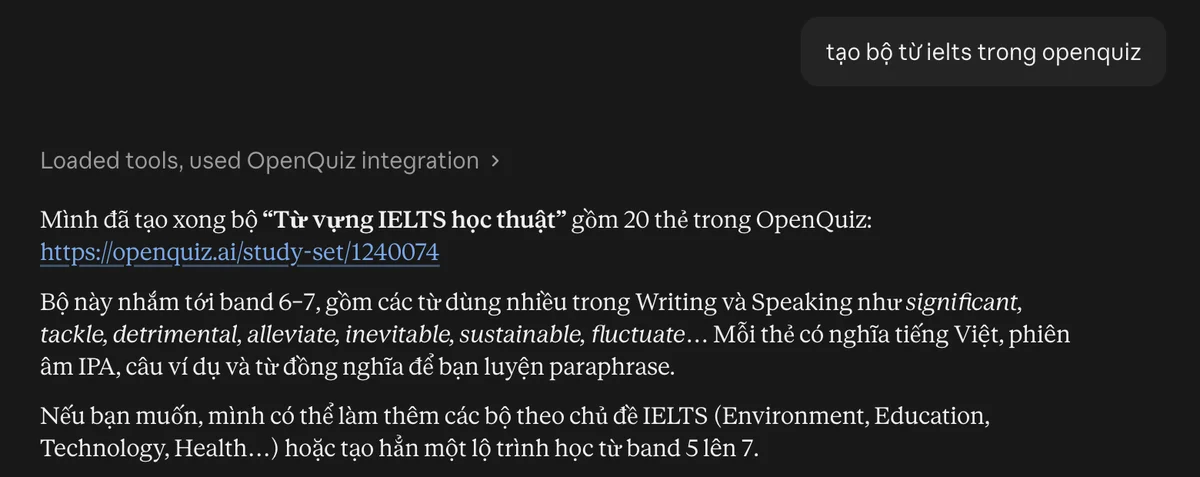
Five things to try, with real results
The screenshot shows the basics. The five examples below go further. They follow one learner who is about to spend an exchange semester in Seoul. We ran every step through the connector's own tools on a test account on November 26, 2026. The assistant wrote the cards; the numbers are what OpenQuiz returned. The wording of Claude's replies will differ from one conversation to the next.
Demo 1
Build a learning path for a goal
A learning path is an ordered series of sets. You study the first set, then the next, until you reach the goal. One request creates the path and all of its sets.
Create a learning path of Korean vocabulary for an exchange semester in Seoul: 3 sets of 8 words, meanings in English.
Saved in OpenQuiz
Korean for a Seoul semester · learning path · 3 sets · 24 cards · private
- On campus (8 cards): 대학교 university, 수업 class, 도서관 library, and 5 more
- Getting around (8 cards): 지하철 subway, 갈아타다 to transfer, ...에 어떻게 가요? asking how to get to a place, and 5 more
- Food and cafes (8 cards): 주문하다 to order, 맵다 to be spicy, ... 주세요 politely asking for something, and 5 more
Every card is written the way OpenQuiz uses it. The term is read aloud and typed in dictation, the meaning is the quiz answer, and the example becomes listening and fill-in exercises:
| Term | Reading | Meaning | Type | Example |
|---|---|---|---|---|
| 도서관 | doseogwan | library | noun | 도서관에서 공부해요. |
| 갈아타다 | garatada | to transfer | verb | 시청역에서 2호선으로 갈아타세요. |
| ... 주세요 | ... juseyo | politely asking for something | phrase | 커피 한 잔 주세요. |
The last row is a grammar card. A pattern is saved with its real words and three dots for the open slot, never as a formula such as "N + V", so the app can read it aloud and recognise it in your own sentences.
Demo 2
Add your own words to a set
Words you met in a class, a book or a video belong in your sets too. Claude fills in the reading, the meaning and an example sentence, and OpenQuiz checks the set before it adds anything.
Add 학생증, 강의실, 동아리 and 도서관 to my On campus set.
Saved in OpenQuiz
- 3 cards added, in your order: 학생증 haksaengjeung student ID, 강의실 ganguisil lecture room, 동아리 dongari student club
- 1 word skipped: 도서관 was already in the set
- The set now has 11 cards
Demo 3
Practise in the chat and save the results
This is the part a plain chat cannot do. After the quiz, Claude saves one result for each card you practised: mastered when you answered without help, learning when you were wrong or needed a hint. OpenQuiz then schedules each card for review.
Quiz me on 6 words from my On campus set and save my results.
Saved in OpenQuiz
| Card | In the quiz | Saved as | Next review |
|---|---|---|---|
| 대학교 daehakgyo | Right, easy | Mastered | In 4 days |
| 수업 sueop | Right | Mastered | Tomorrow |
| 교수님 gyosunim | Needed a hint | Learning | Tomorrow |
| 도서관 doseogwan | Right | Mastered | Tomorrow |
| 숙제 sukje | Wrong | Learning | Tomorrow |
| 시험 siheom | Right, easy | Mastered | In 4 days |
6 results saved, 6 cards scheduled for review. Set progress: 4 mastered, 2 learning, 5 not learned yet. The 6 cards count toward today's study total.
Open the set in the OpenQuiz app afterwards and it is in the same state as if you had studied there. The cards you missed come back first.
Demo 4
Review what is due, and move a review
Claude can read your review queue, across every set or for one set. Right after the quiz above, nothing was due yet:
What do I have to review today?
From OpenQuiz
0 cards are due today. Four cards come back tomorrow and two in 4 days.
When your week changes, the schedule can change with it:
I have midterms this week. Move 교수님 and 숙제 to a week from now.
Saved in OpenQuiz
2 reviews rescheduled. 교수님 and 숙제 are now due in 7 days. The other four cards keep their dates.
On any later day, one sentence starts a review session: "Quiz me on the OpenQuiz cards that are due for review today."
Demo 5
Edit, reorder, and delete only after you say yes
Cards, set titles and the order of the sets in a path can all be changed from the chat. An edit sends only what changes:
In my Food and cafes set, change the example for 메뉴 to 영어 메뉴가 있어요?
Saved in OpenQuiz
1 card updated in "Food and cafes".
Put Food and cafes before Getting around in my Seoul path.
Saved in OpenQuiz
The path now runs: On campus (11 cards), Food and cafes (8 cards), Getting around (8 cards).
Deleting takes two steps. The first request changes nothing. It returns exactly what would be removed, and Claude has to ask you:
Remove 포장 from my Food and cafes set.
From OpenQuiz, before anything is deleted
"Nothing was changed. This permanently deletes 1 card(s) from the set "Food and cafes" ("포장"), with their review schedule."
Yes, delete it.
Saved in OpenQuiz
1 card deleted. "Food and cafes" now has 7 cards.
The same rule covers deleting a whole set, deleting a learning path, and removing cards from spaced repetition.
More prompts that work
- "Make a flashcard set of 20 academic words for IELTS Writing, meanings in Vietnamese."
- "Create a learning path of German vocabulary for moving to Berlin."
- "Turn the new words from this article into an OpenQuiz set." (then paste the article)
- "Which cards in my On campus set am I still learning?"
- "Rename my cafe set to Coffee shop Korean."
- "How many OpenQuiz uses do I have left?"
You do not have to name OpenQuiz every time. Claude uses a connected tool when your request fits it, such as saving words to study later or reviewing saved cards. A one-off translation or a grammar question is answered by Claude alone.
All 20 tools
Claude chooses the tool; you only describe what you want. This list is here so you know exactly what the connector can and cannot do in your account. "Read" tools change nothing. "Write" tools change your OpenQuiz data. Tools marked "asks first" return a summary and wait for your yes before they delete anything.
| Tool | What it does | Type |
|---|---|---|
get_creation_guide | Returns OpenQuiz's rules for cards, sets and learning paths, and the language codes | Read |
get_account_status | Shows your OpenQuiz plan and how many uses you have left | Read |
list_word_sets | Lists the sets you created or are studying | Read |
get_word_set | Reads the cards of one set | Read |
create_word_set | Creates a private set with its cards | Write |
add_cards_to_word_set | Adds cards to one of your sets and skips words already in it | Write |
update_cards | Changes fields of existing cards | Write |
delete_cards | Deletes cards together with their review schedule | Write, asks first |
update_word_set | Changes a set's title, description or languages | Write |
delete_word_set | Deletes a set with all its cards | Write, asks first |
list_learning_paths | Lists the learning paths you created or saved | Read |
get_learning_path | Reads one path and its sets in study order | Read |
create_learning_path | Creates a private path with all its sets and cards | Write |
update_learning_path | Changes a path's title, description, level, its sets and their order | Write |
delete_learning_path | Deletes a path and keeps its sets as separate sets | Write, asks first |
get_study_progress | Shows the status and review schedule of each card in a set | Read |
record_study_results | Saves the results of cards you just practised in the chat | Write |
get_due_reviews | Lists the cards that are due for review today | Read |
reschedule_reviews | Sets the next review date of cards | Write |
remove_cards_from_review | Takes cards out of spaced repetition and erases their review history | Write, asks first |
Changing a set or a path that you have made public in OpenQuiz also asks for your confirmation first, because other learners see the change.
What is free and what is counted
| Action through Claude | Free OpenQuiz account | Premium account |
|---|---|---|
| Reading your own word sets (listing sets, reading the cards of a set), the creation guide and your account status | Unlimited | Unlimited |
| Everything else: creating and editing sets and learning paths, saving study results, the review schedule | 10 uses in total, shared by all of these actions | Not counted |
The 10 uses do not reset. The page where you tap Allow shows how many you have left, and you can ask Claude for the number at any time. Premium accounts have a safety cap of 300 actions a day, which exists only to stop abuse. Studying in the OpenQuiz app itself is not affected by any of this; the plans are on the pricing page.
Privacy and control
- Private by default. Every set and path Claude creates is private until you choose to share it in OpenQuiz.
- Your account only. The connector works inside the account you signed in with. It cannot read or change another user's private content.
- Three permissions, shown before you allow. Create, edit and delete your sets, cards and learning paths; view your sets, learning paths and study progress; save study results and adjust your review schedule.
- Only what a request needs. OpenQuiz receives the content of each tool call, such as the cards to save or the results to record. It does not read your Claude conversations, memory or files.
- Nothing is deleted without a yes. See demo 5.
- You choose which tools Claude may use. In Claude, open the connector under Customize > Connectors and set each tool to Always allow, Needs approval or Blocked.
- Disconnect at any time. Open openquiz.ai/connect/mcp and tap Disconnect, or remove the connector in Claude from its three-dot menu.
What you type in Claude is handled by Anthropic under its own policies. What is stored in your OpenQuiz account is covered by the OpenQuiz privacy policy.
Troubleshooting
| What you see | What to do |
|---|---|
| Claude says it "couldn't reach the MCP server" when you add the connector by its address | Check that the address is exactly https://mcp.openquiz.ai/mcp, with /mcp at the end, then try again. |
| "Authorization with the MCP server failed", or the sign-in page did not finish | Click Connect again and complete the page on openquiz.ai within 10 minutes: sign in, then tap Allow. Allow pop-ups for claude.ai if no page opens. |
| The OpenQuiz page shows Request, or there is no option to add a custom connector | On Team and Enterprise plans only an Owner can add one, so ask your Owner. On the Free plan you can have one custom connector; remove the other one first. |
| Claude answers without using OpenQuiz | Open the + menu in the chat and check that OpenQuiz is turned on for this conversation. Then name it in your request: "…in OpenQuiz". |
| Claude says your free uses are used up | A free OpenQuiz account has 10 uses in total for actions other than reading your sets. Reading your sets keeps working. Premium accounts are not counted. |
| "Too many calls in the last minute" | Wait a minute and continue. This limit protects your account from a runaway conversation. |
| A delete did not happen | Deleting needs a clear yes from you in the same conversation, within about 10 minutes of the question. Ask again and confirm. |
| Claude says the account cannot use connected assistants | Write to us at the address below with the email of your OpenQuiz account. |
If something else goes wrong, email [email protected] with what you asked Claude and the message you got back. To start clean, disconnect at openquiz.ai/connect/mcp, remove the connector in Claude, and add it again.
For developers: it is an MCP server
The connector is built on the Model Context Protocol, the open standard that lets AI assistants call outside tools. The OpenQuiz server is at https://mcp.openquiz.ai/mcp. It speaks Streamable HTTP, signs users in with OAuth 2.0 (PKCE, dynamic client registration), and exposes the 20 tools listed above, each with a title and read-only or destructive annotations. The same server powers the OpenQuiz plugin for ChatGPT.
Frequently asked questions
What is the OpenQuiz connector for Claude?
It is a connector that links Claude to your OpenQuiz account. Claude can then create flashcard sets and learning paths, add or edit cards, quiz you, and save the results to your OpenQuiz progress and spaced-repetition schedule. OpenQuiz is a vocabulary app with flashcards, spaced repetition, dictation and speaking practice.
How do I add OpenQuiz to Claude?
Open the OpenQuiz page in Claude's connector directory at https://claude.ai/directory/connectors/openquiz, or open Customize, then Connectors in Claude and search for OpenQuiz. Select Connect to Claude or Add, sign in to your OpenQuiz account on the page that opens and tap Allow.
Is OpenQuiz in Claude free?
Adding it is free. On a free OpenQuiz account, reading your own word sets through Claude is unlimited, and all other actions share 10 uses in total. Premium accounts are not counted.
Which Claude plans can use it?
OpenQuiz is in Claude's connector directory. If you add it by its address instead, every Claude plan can do that and the Free plan allows one custom connector. On Team and Enterprise plans an Owner connects it for the organization, and each member then connects with their own OpenQuiz account.
Can Claude make flashcards and remember what I got wrong?
Yes, with OpenQuiz connected. Claude writes the cards and OpenQuiz stores them: each card has a term, a short meaning, the word type, the pronunciation and an example sentence. When you practise in the chat, Claude can save each card as mastered or learning, and OpenQuiz schedules the next review.
Can Claude delete my sets or cards?
Only after you confirm. A delete request first returns exactly what would be removed and changes nothing. The deletion happens only after you clearly say yes in the conversation. You can also block the delete tools in Claude under the connector's tool permissions.
Who can see the sets Claude creates?
Only you. Sets and learning paths are created as private and stay private until you choose to share them in OpenQuiz. You can disconnect Claude at any time at openquiz.ai/connect/mcp.
Does it work on my phone?
Add the connector on the web or in the Claude desktop app. Once it is connected, it is available in your Claude conversations on the web, desktop and mobile. The sets you create open in OpenQuiz on the web, iOS and Android.
Try it with the words you need this week
Connect OpenQuiz, name a goal, and let Claude build the path. Your reviews will be waiting in OpenQuiz.
Add OpenQuiz to ClaudeThis guide was written by OpenQuiz. Facts were checked on November 26, 2026. Claude is a trademark of Anthropic; OpenQuiz is an independent product and is not affiliated with Anthropic.